Answers
The scatter diagram shows that, as increases, increases at a decreasing rate on average. This indicate a likely non-linear relationship between and
Since is within the given data range and the is close to our estimate is reliable.
Sketch.
-
The residuals can be negative or positive depending on whether the point is above or below the regression line. Hence, using the sum of the squares of the residuals ensure the error values used in assessing the fit of the model are positive.
-
Sum of squares =
For a line that is a better fit for the data, the sum of the squares of the residuals will be smaller.
Full Solutions
The scatter diagram shows that, as increases, increases at a decreasing rate on average. This indicate a likely non-linear relationship between and
The model gives a better fit to the data as it has an of which is closer to than the of for the model
When
Since is within the given data range and the is close to our estimate is reliable
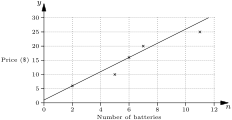
-
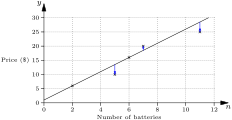
-
The residuals can be negative or positive depending on whether the point is above or below the regression line. Hence, using the sum of the squares of the residuals ensure the error values used in assessing the fit of the model are positive
| 2 | 5 | 6 | 7 | 11 | |
| 6 | 10 | 16 | 20 | 25 | |
For a line that is a better fit for the data, the sum of the squares of the residuals will be smaller
| 2 | 5 | 6 | 7 | 11 | |
| 6 | 10 | 16 | 20 | 25 | |
Considering the sum of squares,